
Breaking news! Trump announced the imposition of tariffs on furniture, which will be implemented within 50 days!

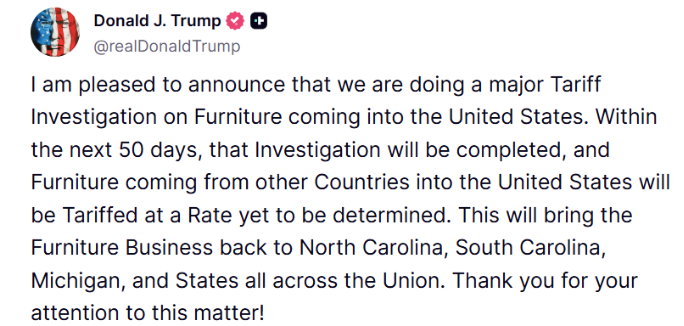
On August 22 local time, Trump announced on social media that the United States has launched a major tariff investigation into "all furniture entering the United States", and it is expected that the assessment will be completed and new tariffs will be implemented within 50 days (by the end of October). The specific tariff rate has not been announced yet. He claimed that this move was aimed at "revitalizing the American furniture manufacturing industry" and promoting the industry's return to traditional manufacturing states such as North Carolina, South Carolina and Michigan.
I. Policy Background and Intent
1? ? employment return target: The number of people employed in the furniture manufacturing industry in the United States is currently about 340,000, only half of the level in 2000, and the problem of industrial hollowing out is significant;
2? ? continues the "America First" strategy: Trump once again uses tariffs as a tool in an attempt to force manufacturing back to the United States;
The previous policies have already shown their effects: the previous tax hikes on furniture imports from Vietnam, China and other countries have led to a continuous increase in furniture prices in the United States (up 7% year-on-year in July), and the growth rates of some subcategories such as office furniture and outdoor furniture have expanded in the past three months.
Ii. Key Data on Trade Structure (2024 to Present)
? total furniture imports in the United States: approximately 26.4 billion U.S. dollars;
? main sources:
Vietnam: Over 7 billion US dollars
China: Nearly 6 billion US dollars
Canada: Approximately 3 billion US dollars
? Any tariff adjustment will directly impact the existing supply chain, especially major export destinations such as China and southeast Asia.
Iii. Immediate Market Response
? retailer shares plunge:
Wayfair dropped 10% in after-hours trading
RH dropped by nearly 10%
Williams-Sonoma dropped by more than 6%
? shares of domestic manufacturer rose: La-Z-Boy (produced in North America) rose 3.7%
Cross-border retail enterprises are under pressure as the market is concerned that rising terminal prices will curb consumption.
Iv. Impact on Cross-border E-commerce and Suggestions
1? ? rising costs: Tariffs may lead to a significant increase in procurement costs, and the pricing strategy needs to be reevaluated;
2? ? inventory and timeliness: During the 50-day window period, goods can be prepared in advance, but inventory costs and risks need to be balanced.
3? ? long-term uncertainty: Tariff policies may extend to more categories (there are currently 11 232 investigations), and policy developments need to be continuously monitored.
Trump's tariff move this time is not an isolated incident but a continuation of his trade protectionist policy. Cross-border furniture sellers should promptly activate response plans, optimize supply chains, control costs, and closely monitor the details of policy implementation before the end of October.
Address:22nd Floor, Block A, Liandu Building Futian Street, Yiwu City, Zhejiang Province
Telephone:0579-85391393
Cell phone:13216796913
;)